Game guide · DELIMETCH
Breakthrough: learn through an example
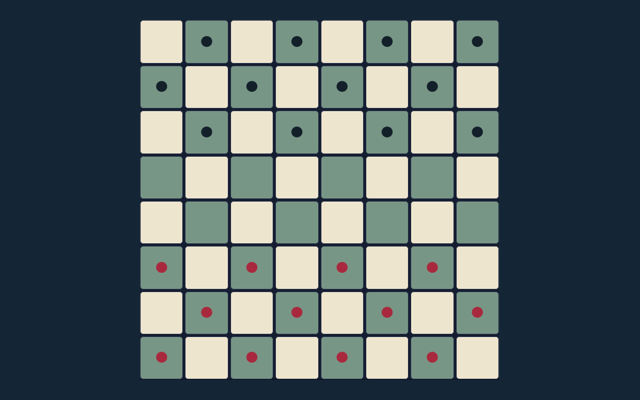
The example and rules describe the same game you can play above. Reach the opposite back row with one of your pieces, or capture all opposing pieces. Start a new round when you are ready to try again. Each player begins with sixteen pieces on the nearest two rows of an 8×8 board.
8×8 board, sixteen pieces per side, basic local computer strategy and same-device play. No promotion, castling or remote multiplayer.
Practice with a purpose
A careful first move helps you understand the round. Capture only one square diagonally forward. Straight captures and backward moves are not allowed. Try the rule on the board, then read the next instruction.
What you are aiming for
Keep the goal in view while choosing a move. Reach the opposite back row with one of your pieces, or capture all opposing pieces.
Follow these playing steps
- Each player begins with sixteen pieces on the nearest two rows of an 8×8 board.
- Blue moves upward and red downward. Move one square straight or diagonally forward into an empty square.
- Capture only one square diagonally forward. Straight captures and backward moves are not allowed.
- Reach the farthest row with any piece, or remove all opposing pieces, to win. Captures are optional.
- Choose a computer opponent or two players on the same device. New round resets the board.
How to use the controls
Use the controls beside the game rather than guessing the rules. Tap one of your pieces, then a highlighted destination. Select a different piece to change your choice. Try the rule on the board, then read the next instruction.
A useful example
A blue piece can advance straight into an empty square or diagonally forward into an empty or red-occupied square. The game area remains available above the explanation.
Keep this in mind
Breakthrough pieces are not chess pawns: diagonal moves into empty squares are legal, and there is no initial two-square move. The game area remains available above the explanation.
More answers before you play
During a round, what is the aim of Breakthrough?
Reach the opposite back row with one of your pieces, or capture all opposing pieces. The controls work with mouse or touch.
For this game, how do the controls work?
Tap one of your pieces, then a highlighted destination. Select a different piece to change your choice. Use the labelled controls for your next action.
For this game, can you show an example?
A blue piece can advance straight into an empty square or diagonally forward into an empty or red-occupied square. A new round resets the current game.
When I start, which mistake should I avoid?
Breakthrough pieces are not chess pawns: diagonal moves into empty squares are legal, and there is no initial two-square move. Scores here do not represent cash or prizes.
During a round, what rules and limits are used here?
8×8 board, sixteen pieces per side, basic local computer strategy and same-device play. No promotion, castling or remote multiplayer. The worked example offers another way to follow the rule.
When I start, how many people can play here?
Computer or same-device 2 players. This is local browser play, not internet matchmaking. The controls work with mouse or touch.
During a round, can I move diagonally without capturing?
Yes. A diagonally forward empty square is a legal destination. The controls work with mouse or touch.
During a round, can I capture straight ahead?
No. Captures must be diagonally forward. A new round resets the current game.
Is capturing compulsory?
No. You may choose any legal move. The instructions above use these same rules.
What wins the round?
Reaching the opponent’s back row with one piece, or capturing every opposing piece. The instructions above use these same rules.